Map how work actually happens.
Oroko is a structured, canvas-first process mapping tool. Capture a process once — the map, the procedure, the analysis and the sign-off all come from the same record, not four separate documents.
 Oroko
Oroko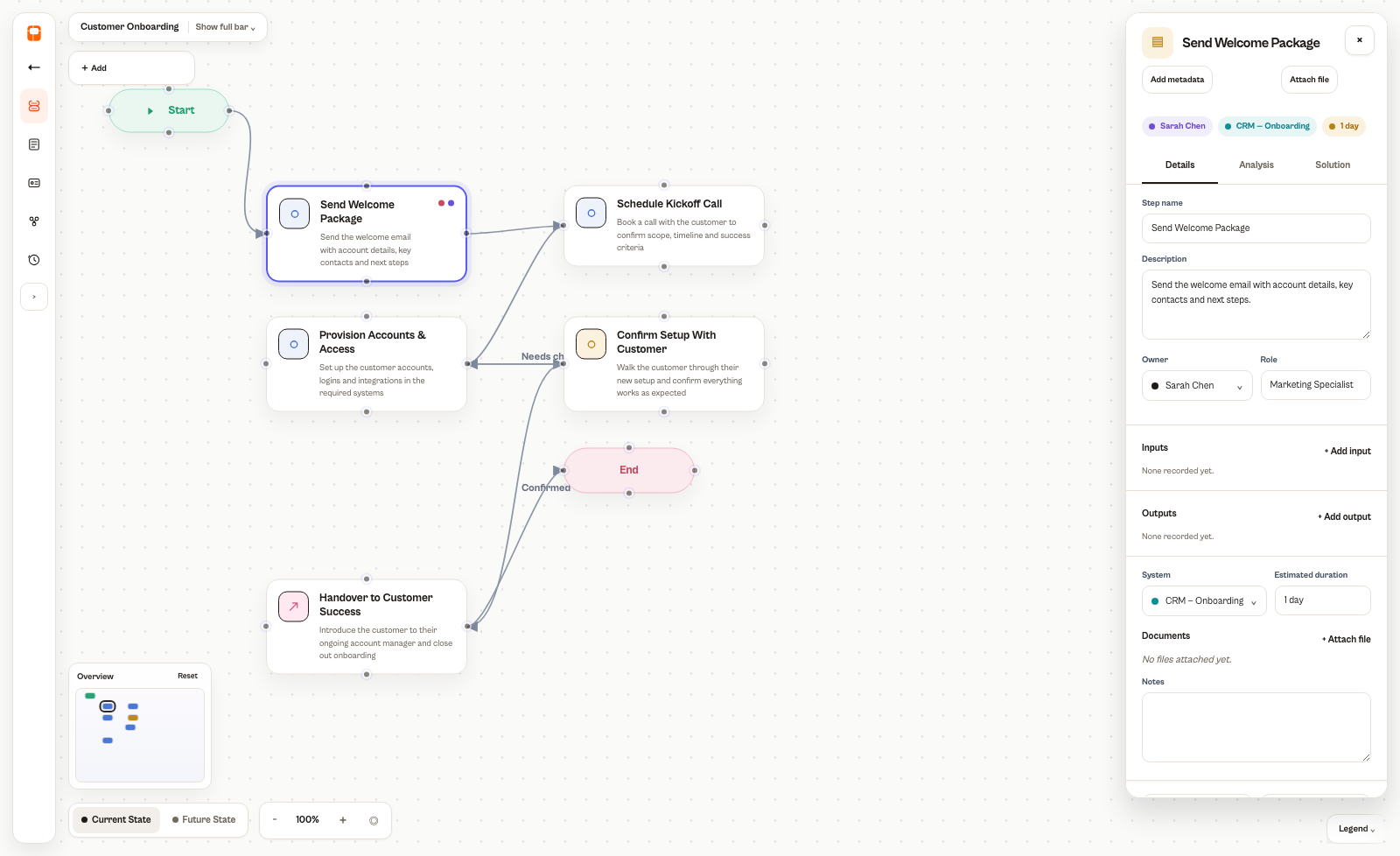
Real screenshot from the Oroko prototype — the Customer Onboarding map, current state.
Built for
The process data is the product. The canvas is just the way you see it — change a step once, and the procedure, the analysis and the sign-off all change with it.
Most process tools make you keep the diagram, the SOP and the risk log in sync by hand. In Oroko they're the same record, viewed three different ways.
More than a diagram.
Capture the process once, then use the same structured information for analysis, future-state design, implementation context and operating procedures.
Structured mapping
Map activities, decisions, owners, systems, inputs and outputs without wrestling with shapes and lines.
Contextual analysis
Attach pain points, risks, assumptions, dependencies and open questions to the exact step they relate to.
Current and future state
Duplicate a process and redesign it with a clear view of what's changing and why.
Procedure generation
Turn the map into a clean operating guide without rewriting the same process in another document.
Governed systems & roles
Owners, roles and systems are managed centrally — add a new one from the canvas, reuse it everywhere.
Portable by design
Import and export JSON so processes can be saved, reused, migrated or generated externally.
Reads like a document your team will actually use.
Every procedure is generated straight from the map — numbered steps, owners and flagged issues, formatted to read like a real operating document instead of an exported diagram.
- Stays connected to the map — edit a step, the document updates itself
- Flagged issues appear as inline highlights, not buried in a separate report
- Click straight through to the exact step on the canvas, and back
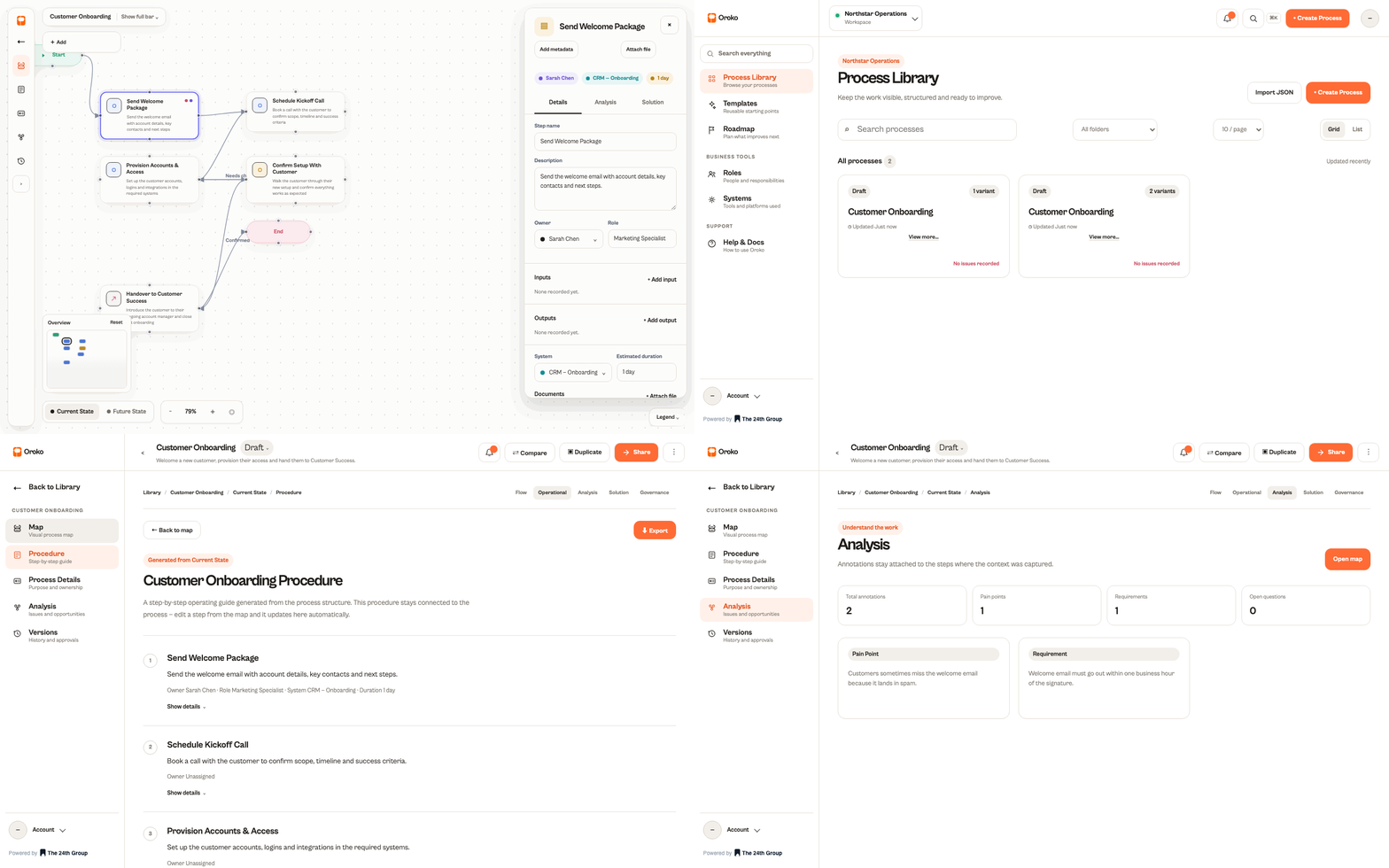
Actual interaction, recorded from the prototype — Library → Map → Procedure → Analysis.
Simple first. Powerful in layers.
A user should be able to map a process in minutes. When the work demands more, Oroko reveals analysis, solution, delivery and governance layers without making the core experience heavy.
One core product. Different working modes.
Use the same structured foundation for current-state discovery, future-state design, process improvement, standard operating procedures or system implementation.
Capture the process live during a workshop or discovery session.
Show the improved process, responsibilities and system actions clearly.
Publish the final approved process as a guided operating reference.
Built to make work easier to understand
Oroko began with a simple idea rooted in Korokoro, the Urhobo word behind its original concept: see clearly.
Too many important processes live across conversations, documents, spreadsheets and disconnected diagrams. Teams may know that work is getting done, but not always how it moves, who owns each step or where the friction sits.
Oroko is being built to change that.
It gives teams one structured place to map how work happens, capture the operational detail behind each step and turn that understanding into procedures, analysis and improved future-state processes. The goal is not to create another complicated diagramming tool. It is to help people move from scattered information to a clear, shared understanding of the work.
Why we're building it
We believe process tools should support the conversation rather than slow it down. A user should be able to map a process during a workshop, add the right context as they learn more and produce useful documentation without rebuilding the same information in several different tools.
That's why Oroko is designed to be:
- Simple enough to use from the first step
- Structured enough for professional work
- Visual without becoming an infinite whiteboard
- Detailed without making the canvas feel crowded
- Useful across discovery, operations, redesign and governance
Designed to feel calm, clear and professional.
Explore the redesigned Oroko app prototype and test the interaction model.